The History of the Buffalo Soldiers

 Podchaser

 Spreaker

 Pandora

 RSS Feed

 YouTube

 Apple Podcasts

 Spotify

 Amazon Music

 Overcast

 Castro

 Castbox

 TuneIn

 RadioPublic
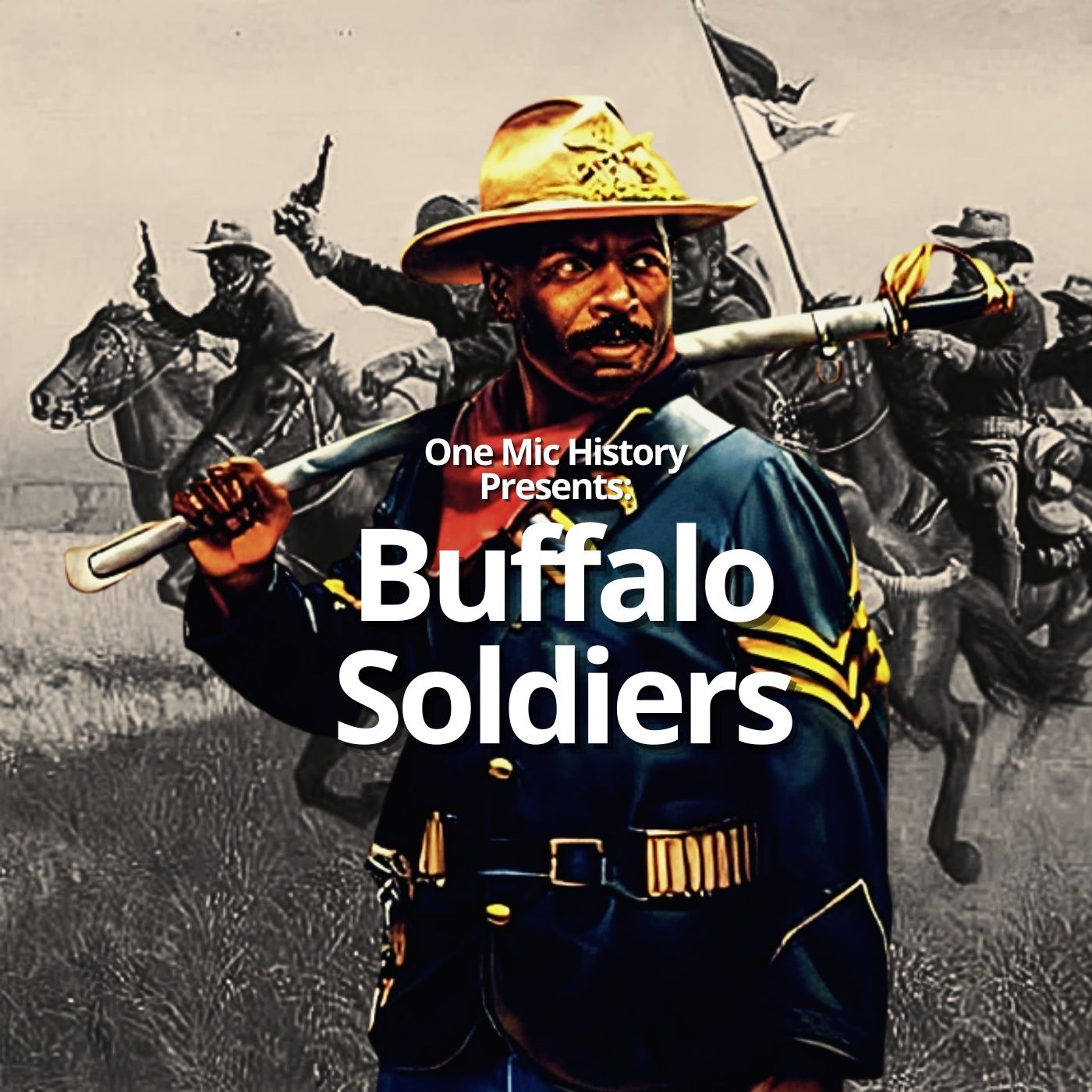
In 1866, Congress decided to form the first all-Black Army regiments in peacetime: the 9th and 10th Cavalry, and the 24th and 25th Infantry. For many Black men, especially those just freed from slavery or who’d worn Union blue during the war, the military offered something rare: steady work, a chance for education, and maybe a little dignity in the era of Jim Crow.
Audio Onemichistory.com
Follow me on Instagram: @onemic_history
Follow me on Substack: https://onemicblackhistorypodcast.substack.com/
Follow me on Threads: https://www.threads.net/@onemic_history
Please support our Patreon: https://www.patreon.com/user?u=25697914
Buy me a Coffee https://www.buymeacoffee.com/Countryboi2m
Sources
https://en.m.wikipedia.org/wiki/Buffalo_Soldier
https://www.chron.com/culture/article/beyonce-buffalo-soldier-20389446.php https://www.nps.gov/yose/learn/historyculture/buffalo-soldiers.htm https://nmaahc.si.edu/explore/stories/buffalo-soldiers
The forgotten heroes _ the story of the Buffalo Soldiers by Clinton Cox A Narrative of the Negro Cavalry in the West by William H. Leckie
Become a supporter of this podcast: https://www.spreaker.com/podcast/one-mic-black-history--4557850/support.
0:00 You've seen the photos of Beyonce dawning a Buffalo Soldier's T shirt during her Cowboy Carter tour. Some held it as a powerful tribute, but critics immediately accused the Grammar Winner of military propaganda and glorifying genocide against Native Americans. The controversy centered around the language on the back of the T shirt, which explicitly stated that the Buffalo Soldiers antagonists were enemies of peace, order and settlement, warring Indians, bandits, cattal thieves, murderous gunmen, bootleggers, trespassers, and Mexican revolutionaries. Many were quick to highlight the deeply paradoxal and controversial role black regiments played in the United States web expansion. Yet the difficult truth is is that the Buffalo Soldiers were a paradox. They were men who fought bravely and made significant contributions to a country that often treated them like less than human. So today join us while we tell the real story of the Buffalo Soldiers. And he likes stories like this. You can find more stories like this at onemikehistory dot com. I also have a stub stack.
1:09 I would love to see you there. We also have a podcast. You can find our podcast one Mike Black History wherever you get your podcast. But without further ado, let's get started. So who are the Buffalo Soldiers? Well, let's rewind back to eighteen sixty six, in the end of the Civil War of the South is in ruins. Over four million newly freed African Americans are trying to find their place in a country that had mostly seasoned as outsiders. Then Congress does something different. They form the first peace time all Black Army Regiment, the ninth and tenth Cavalry and the twenty fourth and twenty fifth Infantry.
1:51 For a lot of black men, especially those who knewly been freed or who had fought for the Union, their army offered steady pay, chance to learn, and maybe some respect in a world where separate but equal was the rule. The catch respect was rare, and inside the army racism was everywhere. Mostly white officers wanted nothing to do with black regiments. Some would take demotions rather than lead them Offers who did stay often wanted quick promotions rather than real change, which meant poor leadership and few role models. General Ulysses Grant had to remind his officers that they actually had to support their new troops, and no matter how hard they worked, black soldiers faced discrimination not just outside their ranks, but inside the chain of command from the top down. So because of this, promotions for black soldiers were almost impossible. The army capped their advancement, cementing their outsider status. Henry O. Flipper, the first black West Point graduate, remembered that during my four years in the academy, I never had the happiness of being invited to a cadets quarters, not once I became a man of reserve, because I couldnot be otherwise. This sense of isolation, of always having to prove yourself in institutions that were built to keep you out. Follow the Flipper and the Buffalo
3:23 soldiers wherever they went, and they went a lot of places, but mostly straight to the frontier, the wild West. Their orders were to build forts and protect mail routes and settlers, and most faithfully fight in the Indian Wars. The United States wanted more land and more resources, and these troops became a tool for that expansion. So imagine you're a black soldier, newly free from enslavement, and now you are enforcing the government's policies that push Native people off their land. This is a twisted form of irony. One group who had just tasted freedom now caught up in someone else's fight for survival. And they did all of this with secondhand uniforms and leftover gear from the Civil War. The horse and their saddles were falling apart. Commanding officers wrote angry letters about how their saddles barely filled their mounts and the broken equipment. Yes, the whole army had shortages after the Civil War, but black regiments were the last of the last in line. In addition to all of this, they were sent to the toughest, most isolated frontier posts because white communities didn't want to see black soldiers around, so loneliness, prejudice, and violence from the locals became a
4:54 daily occurrence. Texas was especially harsh. Black soldiers survived daily attack and were often blamed for the trouble, sometimes unfairly, and many of them were court martialed for it. Despite all of this, they got the job done. They fart hard against the Mexican border raids in tough terrain deep prejudice. The name Buffalo soldiers was a name they earned, maybe it was because of their hair, maybe it was because of their bison coats or their fighting spirit, but the name stuck and the soldiers wore it with pride. The phrase buffalo soldiers would later become a generic term for all black soldiers, and it's now used for army regiments and trace the direct lineage back to black regiments formed in eighteen sixty six. But the Buffalo soldier's story isn't just about fighting, It's about perseverance. The army made their lives very difficult, giving them worn out gear, assigning in the toughest, loneliest posts scattered from Texas to Montana. Many communities, especially after the end of reconstruction in the South, pushed to keep black people, especially those in uniforms, far away, fearing that they would disrupt the racial order. So when they were sent to isolate it sometimes perilous regions, sometimes facing hostility from the white settlers who saw them as enemies as they were posed to fight. The Buffalo Soldiers stuck it out, and these regiments earned over twenty medals
6:25 of honor, an extraordinary achievement despite everything that was stacked against them. So when Americans started protecting wild spaces. The Buffalo Soldiers were among the very first park rangers at Yosemite, Sequoia, and what is now Kings Canyon. They built trails, they stopped poachers, they fought wildfires, and became the pioneering stewards of our national parks, years before the National Park Service was even founded. Captain James Young, who became the first black superintended over a national park, would stay. Thank God, I'm able to say that I am a soldier and a man, and that I am able to render a service to my country, and that the cause of which is never dead, the cause of right and humanity. But their contributions to this country did not shield them from injustice.
7:21 Coming home meant fighting Jim Crow and rising violence against black veterans. The Red Summer of nineteen nineteen saw Black soldiers, some of them still in uniform, being intact or even killed for daring to hold their head high and serve their country. When trouble erupted, such as the Brownsville affair, entire companies of Buffalo soldiers were discharged, their career is destroyed on shaky testimony and rigged investigations. Presidents promised the Buffalo soldiers that their service would open doors in time, and time again, those doors were slam shut in their face. The armament wouldn't truly These segregated into Truman's Order in nineteen forty eight, and even then real integration took much much longer, But the Buffalo Soldiers had elastic impact through all of this. They built the legacy. They weren't just stationed in lonely poles. They marched and rolled across the American frontier after the Civil War in places like Texas and Kansas, where they became legendary horsemen in a world where the odds were completely stacked against them. Later, they fought overseas and places like Cuba during the Spanish American War, where they charged up San Juan Hill alongside Teddy Roosevelt the rough Riders. In the Philippines, they served with distinction, even as some Americans questioned their right to even wear the uniform. Back home, segregation laws kept the army and society as unequal as ever, but the legacy of these
8:53 black regiments reached far, and they helped build roles in infrastructure and build settlements, and most crucially, trained generations of future army leaders. Both white and black. Their courage and grit quietly open doors for future integrations of the military, set in the groundwork for the disegregation of the armed forces. Their service made undeniable the argument that Black Americans were willing and able to serve their country even while the country refused to serve them equally. And while the Buffalo Soldier's story is full of contradictions, yes, they played a major part in America's expansion westward, sometimes fighting against Native Americans, many of who was face owned injustice and displacement. This puts the Buffalo Soldiers in a complicated place in Black history.
9:43 Freedom fighters for themselves, yes, but also instruments of government policy that harmed others. They built literal roads of opportunity and carved out freedom for their own families, even as they were denied basic right to vote, fair pay, and equals under the law. Yet through the humiliation, danger, and doubt, they kept showing up, driven by the whole that heavy hard one step forward would mean something bigger than just themselves. So why does any of this matter? Because the Buffalo Soldiers remind us that American history is not simple, never simple. It's layered with conflict and courage and hope, and legacy is one of pride and paradox of grit and enduring questions about belonging. Maybe that's why this story still speaks to Black folks, whether it's a song or headline or choirt trail in an old forest. They carved out of space for themselves and for generations to follow, and honestly, they challenge us to make sure that no part of our history, no matter how complex, it's, left in the shadows.
10:54 Thank you. This is one of my Black history. I'm a hust country boy and this is the story of the Buffalo Soldiers. I would love to know what you think of the Buffalo Soldiers' legacy. Please drop a comment below. Please subscribe to the podcast. You can find our podcast wherever you get your podcasts, and you can follow us on substack. I pose black history notes every single day and write articles every single week. I would like to thank all my financial contributors. Without you, none of this could be possible. I love you all. Peace.